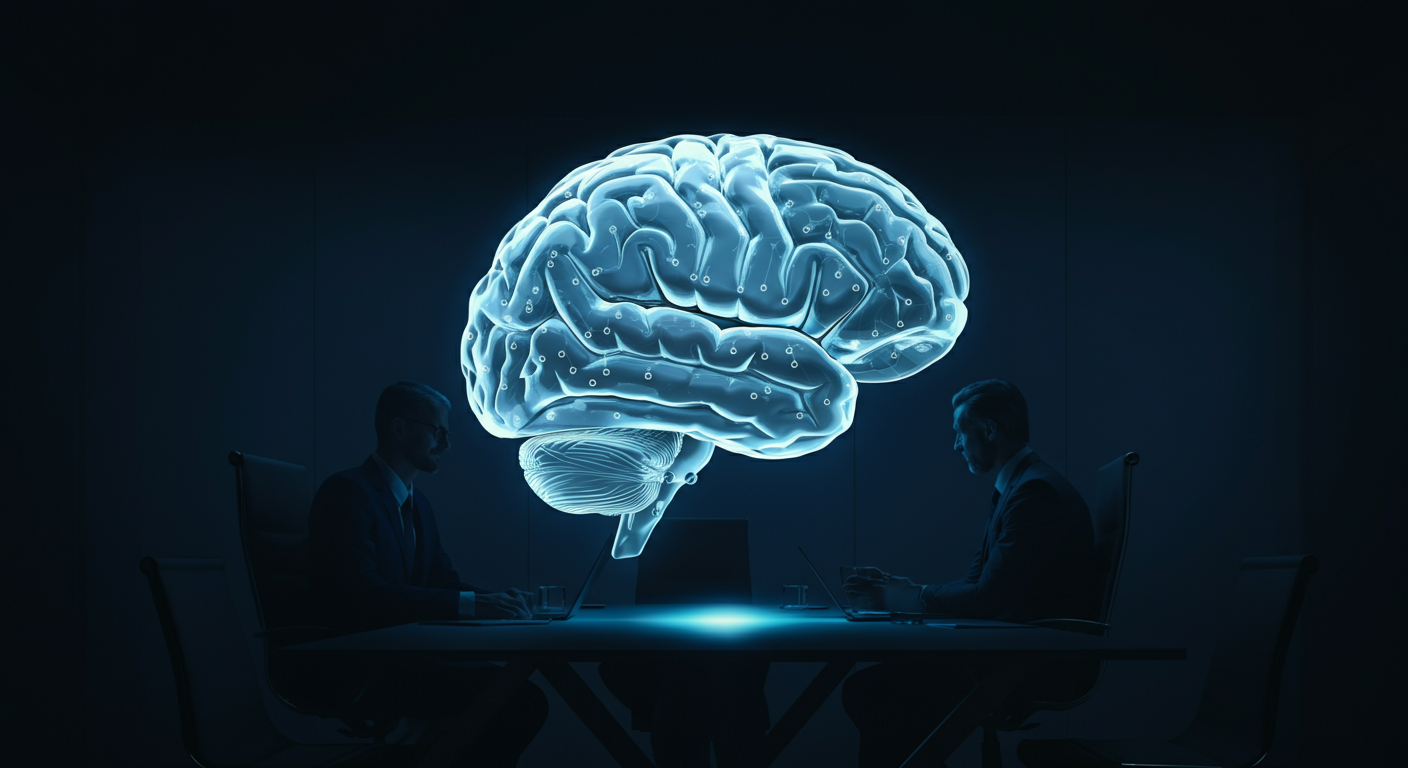
The Neuroscience of Decision Making in Business

Michael Stanley
Research Team, Impact Yes
We like to think of business decisions as rational. We build models, analyze data, run projections, and construct logical arguments. We present our conclusions in slide decks and spreadsheets that suggest a level of analytical rigor that would make any economist proud.
And then we make the decision based on how we feel about it.
This is not a criticism. It is a neurological fact. The human brain does not make decisions the way a computer processes data. It makes decisions through a complex interplay of emotion, intuition, memory, social influence, and cognitive shortcuts — with rational analysis playing a supporting role rather than the leading one.
Understanding this is not just intellectually interesting. It is practically essential for anyone who makes decisions in a business context — which is to say, everyone.
How the Brain Actually Makes Decisions
Neuroscientist Antonio Damasio's research on patients with damage to the emotional centers of the brain revealed something counterintuitive: people who cannot feel emotions cannot make decisions. Even simple ones.
This finding overturned the assumption that emotion is the enemy of good decision-making. In reality, emotion is essential to it. The brain uses emotional signals — what Damasio called somatic markers — to rapidly evaluate options and guide decision-making. Without those signals, the decision-making process breaks down entirely.
This does not mean that emotion always leads to good decisions. It means that understanding the role of emotion in decision-making is essential for improving the quality of decisions.
System 1 and System 2 Thinking
Psychologist Daniel Kahneman's framework of System 1 and System 2 thinking provides a useful model for understanding how the brain makes decisions.
System 1 is fast, automatic, and intuitive. It operates below conscious awareness, drawing on pattern recognition, emotional signals, and cognitive shortcuts to make rapid judgments. It is efficient and often accurate — but it is also prone to systematic biases.
System 2 is slow, deliberate, and analytical. It is the part of the brain that does the careful, logical reasoning we associate with rational decision-making. It is more accurate in complex situations — but it is also effortful and easily fatigued.
Most business decisions are made primarily by System 1, with System 2 providing post-hoc rationalization. Understanding this changes how we think about decision quality.
The Cognitive Biases That Distort Business Decisions
Because most decisions are driven by System 1 thinking, they are subject to a range of cognitive biases — systematic errors in thinking that affect the quality of decisions in predictable ways.
Confirmation Bias
Confirmation bias is the tendency to seek out and favor information that confirms what we already believe. In business, this shows up when leaders surround themselves with people who agree with them, when teams interpret ambiguous data in ways that support their preferred conclusion, and when organizations continue investing in failing strategies because the evidence of failure is uncomfortable to acknowledge.
Anchoring
Anchoring is the tendency to rely too heavily on the first piece of information encountered when making a decision. In negotiations, the first number on the table has a disproportionate influence on the final outcome. In strategic planning, the first option presented tends to anchor the discussion in ways that limit creative thinking.
Loss Aversion
Loss aversion is the neurological tendency to feel losses more acutely than equivalent gains. Research shows that the pain of losing something is roughly twice as powerful as the pleasure of gaining something of equal value. In business, this leads to excessive risk aversion, reluctance to abandon failing strategies, and decision-making that prioritizes avoiding loss over pursuing opportunity.
The Halo Effect
The halo effect is the tendency to let a positive impression in one area influence our judgment in other areas. In hiring, this leads to overvaluing candidates who are articulate or attractive. In leadership, it leads to overvaluing the opinions of people who have been successful in the past, regardless of whether their past success is relevant to the current decision.
How Neuroscience Improves Business Decision Making
Understanding the neuroscience of decision-making is not just about knowing the biases. It is about designing decision-making processes that account for how the brain actually works — and that produce better outcomes as a result.
Design for Cognitive Diversity
One of the most powerful ways to improve decision quality is to ensure that decisions are made by groups with diverse cognitive and behavioral profiles. When everyone in the room thinks the same way, the same biases are amplified. When people with different behavioral patterns and cognitive styles are involved, biases are more likely to be caught and corrected.
This is one of the reasons why behavioral assessment tools like Pactomics are so valuable in organizational decision-making. By understanding the behavioral profiles of decision-makers, organizations can design decision-making processes that leverage cognitive diversity rather than suppress it.
Create Conditions for System 2 Thinking
System 2 thinking — the slow, deliberate, analytical kind — requires cognitive resources that are easily depleted. Decision fatigue, stress, time pressure, and information overload all push decision-making toward System 1, increasing the influence of biases.
Organizations that want better decisions need to create conditions that support System 2 thinking: adequate time for deliberation, manageable decision loads, psychological safety to challenge assumptions, and processes that require explicit consideration of alternatives.
Make Biases Visible
The most effective way to reduce the influence of cognitive biases is to make them visible. When decision-makers are aware of the specific biases that are likely to affect a particular decision, they can take deliberate steps to counteract them.
This requires a culture of intellectual honesty — where it is safe to challenge assumptions, question conclusions, and point out when a decision process may be compromised by bias.
The Behavioral Dimension of Decision Making
Decision-making is not just a cognitive process. It is a behavioral one. And the behavioral patterns of individual decision-makers — their communication styles, their risk orientations, their relationship to authority and autonomy — have a significant influence on the quality of decisions.
This is where the Pactomics assessment provides unique value. By mapping the behavioral patterns of leaders and teams, Pactomics reveals how those patterns influence decision-making — and provides a foundation for developing more effective decision-making practices.
How Behavioral Patterns Affect Decision Quality
Consider a leadership team where the dominant behavioral profile is action-oriented and risk-tolerant. This team will make decisions quickly and boldly — which is a strength in fast-moving environments. But it may also make decisions without sufficient deliberation, underestimate risks, and fail to consider the perspectives of more cautious team members.
Or consider a team where the dominant profile is analytical and risk-averse. This team will make careful, well-considered decisions — but may be slow to act, overly cautious in the face of opportunity, and prone to analysis paralysis.
Neither profile is inherently better. But understanding the behavioral profile of a decision-making team — and designing processes that compensate for its limitations — is essential for consistently good decision-making.
Practical Takeaways
- Recognize that most business decisions are driven by System 1 thinking. Design your decision-making processes to engage System 2 where it matters most.
- Learn the cognitive biases most likely to affect your specific decision-making context and build in explicit checks for them.
- Use behavioral assessment tools like Pactomics to understand the behavioral profiles of your decision-makers and design processes that leverage cognitive diversity.
- Create organizational conditions that support good decision-making: adequate time, manageable decision loads, psychological safety, and a culture of intellectual honesty.
- Treat decision-making as a skill that can be developed — not just a natural talent that some people have and others do not.
Frequently Asked Questions
How does neuroscience explain business decision making?
Neuroscience shows that business decisions are driven by a complex interplay of emotion, intuition, memory, social influence, and cognitive shortcuts — with rational analysis playing a supporting rather than leading role. Understanding this helps leaders design better decision-making processes.
What are the most common cognitive biases in business?
The most common cognitive biases in business include confirmation bias, anchoring, loss aversion, the halo effect, groupthink, and the sunk cost fallacy. Each of these can significantly distort decision quality in predictable ways.
How can organizations improve their decision-making quality?
Organizations can improve decision quality by designing for cognitive diversity, creating conditions that support deliberate thinking, making biases visible, and using behavioral assessment tools to understand how individual behavioral patterns influence decision-making.
What is the role of emotion in business decision making?
Emotion is essential to decision-making — not its enemy. The brain uses emotional signals to rapidly evaluate options and guide decisions. The goal is not to eliminate emotion from decision-making but to understand its role and design processes that channel it productively.
How does Pactomics help with decision making?
Pactomics maps the behavioral patterns of leaders and teams, revealing how those patterns influence decision-making. This understanding allows organizations to design decision-making processes that leverage the strengths of their behavioral profiles and compensate for their limitations.
Conclusion
Business decisions are not made in a vacuum of pure rationality. They are made by human brains — complex, emotional, bias-prone, and deeply social. Understanding the neuroscience of decision-making does not make decisions easier. But it makes them better.
The organizations that invest in this understanding — that design their decision-making processes around how the brain actually works — will consistently make better decisions than those that cling to the fiction of pure rationality.
At Impact Yes, we help organizations build the behavioral intelligence and decision-making capability they need to perform at their highest potential — through the Pactomics assessment, our leadership development programs, and our organizational consulting.
Ready to Improve Decision-Making in Your Organization?
Book a Pactomics Assessment to understand the behavioral patterns that drive your team's decisions. Schedule a Leadership Training session to develop decision-making skills grounded in neuroscience. Contact Impact Yes to design a decision-making development program for your organization.